Plant Shelf Styling Ideas That Look Designed, Not Cluttered
My first plant shelf had twelve pots in seven colours. Taking everything off showed me the fix in ten minutes. It cost nothing, and the shelf has looked designed ever since.
How do I reset a cluttered plant shelf in 10 minutes?
Take everything off the shelf. Every pot, every book, every little decor piece. All of it, onto the table. Now look at the empty shelf, and breathe, because this is the moment your shelf starts looking designed.
Here is the happy rule for what goes back: keep three to five plants per shelf, maximum. If you own twelve small pots, keep the five healthiest and move the rest to another room, or give them to a friend. The ones that go back are the healthiest plants, the pots that match, and the pieces you actually love. Everything else finds a new home, and that is a gift, not a loss. Going forward, use the one-in, one-out rule: a new plant means one leaves the shelf, and your shelf stays beautiful.
Editing a shelf is a happy skill, not a failure. The plants that come off go to a windowsill, a friend, or a propagation jar, where they get a fresh start. Here is the test that makes it easy: take a phone photo of the shelf and squint at it. Whatever still stands out is worth keeping, and whatever melts into a green blur can move somewhere it shines better. Cap the trailing plants at one or two per shelf area. Train all the vines to fall on the same side, not both sides. Vines falling together on one side look tidy and calm, while vines in every direction make even healthy plants look busy.
Which shelf gets the most light, and which plants go where?
The wall beside the window wins every time. Stand where the shelf will go and ask how much sky you can see from that spot. A lot of sky means good light, and a sliver of sky means low light. If you can see no sky at all, that spot is happiest with a picture or a decor piece. Your plants will love a brighter wall nearby.
Light drops fast from top to bottom. The top shelf is the brightest, and the bottom shelf is the darkest. Match the plant to the tier, and every plant gets the light it loves. Here is a test that takes thirty seconds. Download a free lux or light-meter app, hold your phone at shelf height at noon on a cloudy day, and read the number. Under about 100 foot-candles, which is roughly 1,000 lux, a ZZ plant, a snake plant or a cast iron plant will hold up beautifully. Between 100 and 200 foot-candles, pothos and philodendron are happy. Succulents and string of pearls need 200 foot-candles or more, so they belong on the top shelf nearest the window. One foot-candle is about 10.8 lux, so the app reading makes sense once you know that.
A shelf across the window can work wonderfully, and glass or clear acrylic shelves let light through to the tier below, which keeps every plant happy. Wood shelves across a window shade everything beneath them, so they suit a wall spot better. Acrylic yellows and scratches within one to two years. Glass shelves need weekly cleaning because dust shows instantly. They hold less weight, usually 5 to 7 kg per shelf, so check the rating and choose the one that fits your plants. A shelf above a radiator loves a little extra water, roughly twice as often. Hot dry air browns leaf edges and dries the soil unevenly, and a happy routine keeps the leaves lovely. In winter most houseplants want about half the water they take in summer. A cold windowsill holds moisture for days, so a shelf plant on a winter schedule stays healthy and rot-free. The light decides everything, so test it before you style anything, and your plants will thank you.
What is the shelf formula that always looks designed?
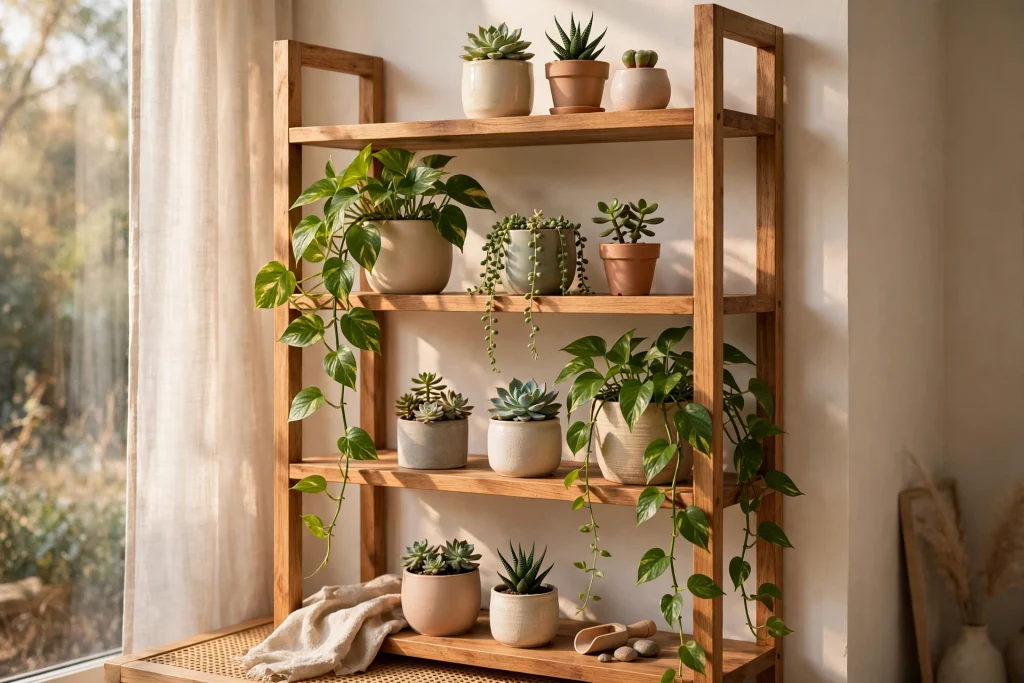
Every good shelf follows the same happy rhythm, and it has a florist’s name: thriller, filler, spiller. Something upright on top, something bushy in the middle, and something trailing at the bottom. Upright plants give height, bushy plants give fullness, and trailing plants soften the edges beautifully. Use odd numbers, three or five plants per shelf, and leave about a third of each shelf empty. That empty space is what makes the whole thing look designed instead of crowded.
Here is a ready formula that works every time. One tall plant, one trailing plant, one compact plant, plus a book or a tray, plus one decor object, plus empty space. Three ready-made combinations to steal. Clean and minimal: one snake plant, one pothos and one peperomia in matching white pots. Cosy and full: a trailing pothos, a bushy calathea and a small fern with a wooden tray. Small shelf: one ZZ plant and one trailing hoya, and nothing else. Leave 10 to 15 cm of clear air between mature plants so the leaves have room to breathe. Leaves with space stay dry, healthy and beautifully shaped. Plan for growth too. A shelf that looks perfectly full on day one is overcrowded in six months. Leave one deliberate gap per shelf for the plants to grow into, and it will look even better.
One accent per shelf, maximum three across the whole unit, and natural materials only: wood, stone or ceramic. Keep books safe by putting a riser or a tray under every pot, so a saucer leak never reaches them. Keep lit candles on a different shelf from dry trailing leaves, and your home stays cosy and safe. Balance visual weight, not symmetry: one large plant on the left balances a cluster of three small objects on the right. The eye should travel in a zigzag, high, low, high, not a flat line. One plant breaking the horizontal line, a vine falling past the shelf below, is what makes the unit look grown, not arranged. For trailing inspiration, our guide to climbing plants shows which ones trail beautifully and which ones need support.
What size pot should I use on a plant shelf?
Keep your pots to two or three colours at most, and repeat one material across the shelf. Cream and terracotta, white and warm beige, sage and cream, matte black and wood, all of these work beautifully. Pick one combination and stick to it, and the shelf pulls together instantly.
Here is the pot-size secret that makes shelf plants thrive. The pot diameter should be roughly one-third of the plant’s leaf-span, and when you repot, go only 2 cm wider than the last pot. A small peperomia is happiest in a 10 to 15 cm pot, where it stays cosy and dries out just right. Shelf plants belong in 10 to 15 cm pots, because anything bigger is too heavy and too deep for a 20 to 25 cm shelf. If a pot feels too big, a smaller pot is the happy fix, and your plant will perk up.
Mismatched pots are the fastest fix in this whole article. One can of matte spray paint, around $5 to $8, in cream, terracotta or sage, turns five random pots into a set in an afternoon. Paint the outside only, never the inside, and let it cure for 24 hours before potting. Woven baskets work as cachepots too, and they hide plastic nursery pots for almost nothing secondhand. Here is the weight rule that keeps your shelf safe and happy. A wet 15 cm terracotta pot weighs 2.5 to 3 kg, and glazed ceramic is heavier still. Lightweight plastic nursery pots inside a decorative cachepot cut the weight by a third and make the lift-out watering method possible. Use flat-based pots only on shelves, because they sit steady and safe. Our picks for the best planters for small apartments will help you choose the right size and weight.
How do I hang a plant shelf without drilling?
You do not need to drill a single hole to have a beautiful plant shelf. A leaning ladder shelf, a tension-pole unit, a freestanding étagère or bookcase, a rolling cart, or over-door hooks all work wonderfully. You take them with you when you move.
Here is the number that keeps your shelf safe. A standard removable adhesive hook holds about 1 to 3.5 kg each. Check the packet, because a small hook is often rated for just 1 kg. A wet 15 cm terracotta pot weighs 2.5 to 3 kg, so two hooks per shelf, or a rated rail, holds it happily. Nano-adhesive loves smooth walls and skips textured or uneven ones. Test any removable hook on a hidden patch of skirting board or inside a cupboard for 48 hours before trusting it with a plant. Then you will know it holds.
Tension-pole systems love a solid ceiling, and they sit beautifully on one, while a false or dropped ceiling is not the right home for them. The pole foot can dent soft vinyl flooring or leave a ring, so check both before you buy, and your floor stays lovely. Only use tension systems designed and rated for plants, never a curtain rod, because a plant-rated system holds your shelf safely. Keep the total load under the manufacturer’s rating with a 30 percent buffer. That means the pot weight times the number of pots, plus 30 percent, and your shelf stays strong.
Here is the happy truth about deposits: water is the thing to watch, and a simple routine keeps your deposit safe. Every pot on a saucer, a cork mat or a waterproof tray, even the ones you never overwater, keeps engineered wood looking lovely and walls dry and fresh. Once a month, lift the pots nearest the wall and check for damp patches or a musty smell, and a quick check keeps everything sweet. On carpet, put a cheap waterproof mat under the whole unit. Holes can be filled for pennies, and a saucer habit keeps the wood beautiful. If you love the vertical look, our guide to hanging planters shows how to use the space above your shelf without drilling.
Which shelf plants are safe for pets and toddlers?
Here is the happy fix every best-shelf-plants list skips. Pothos, philodendron, monstera, snake plant, ZZ plant, peace lily and aloe vera are all listed as toxic to cats and dogs by the ASPCA. They contain calcium oxalate crystals. The safe swaps below give you the same beautiful look with complete peace of mind.
The safe swaps look just as good. A spider plant called Bonnie trails beautifully and is completely non-toxic. Peperomia Hope or Watermelon is compact and beginner-proof. Calathea and prayer plant have patterned leaves and love low light. Parlor palm, Boston fern, Chinese money plant and polka dot plant, with its pink and red colour, all look wonderful on a shelf and are safe for pets. The rule is simple and happy: toxic plants go on high shelves only, above about 1.2 metres, out of a jumping cat’s easy reach. Or you can skip them entirely and enjoy the safe list. Pet-safe plants can go low, and everyone stays happy.
Cats are not just chewers, they are part of the family. A freestanding ladder shelf with a low, wide base and an anti-tip strap stays steady and safe. It holds even when a 4 to 5 kg cat lands on the top shelf. Keep tempting trailing vines, and spider plant babies are cat magnets, out of launch range, and your shelf stays beautiful. Deterrents that work happily: double-sided tape strips on the shelf edge for a week, and citrus peel near the pots but not in them. Give the cat its own permitted perch nearby, so everyone has a favourite spot.
For toddlers, a sturdy shelf is a happy shelf. Anchor every freestanding unit into the wall studs with an anti-tip kit. A metal bracket or strap costs around $10 to $15, takes 15 minutes to fit, and your shelf stays rock-solid. Put the heaviest pots on the bottom tier to lower the centre of gravity. Choose shatterproof pots over glass or ceramic, and skip small decor that could be a choking hazard. Keep dangling cords from grow lights or macramé out of reach, so little hands stay safe. Cover exposed soil with large pebbles so toddlers cannot eat the soil, and it stops cats digging too. Keep the shelf out of the main play area, or behind a baby gate if you can. Once a month, do a two-minute safety check: tug the anchor straps, wobble-test the frame, and if anything wobbles, fix it now and it stays safe. Check the felt or rubber pads under the legs, and rebalance after repotting. A plant’s weight and centre of gravity change as it grows, and a quick check keeps everything steady.
How do I water shelf plants without making a mess?
Group your plants by water need, one tier at a time. Put the thirsty plants together on one tier, fern, calathea and peace lily, and water them when the top 2 cm of soil feels dry. Put the drought-tolerant ones together on another tier, snake plant, ZZ plant and succulents. Water them every 2 to 3 weeks, only when the soil is fully dry. One watering can pass then waters a whole tier correctly, instead of five plants five different ways. Low-light plants grow slower and need less water, so a shelf plant on a gentle schedule stays happy and healthy.
Water until it just runs through the drainage holes, then tip the saucer out after 20 minutes. An empty saucer keeps wood beautiful and the air fresh, so make tipping it out part of the routine. Reach is destiny in the happiest way. Put the thirstiest plants at eye level or below, where watering takes two minutes. Put the drought-tolerant ones, snake plant and ZZ plant, on the top shelf, where they are happy with less attention. Keep a small 0.5 to 1 litre narrow-spout can on the shelf itself, so watering takes two minutes, not a trip to the kitchen.
Dust settles faster at shelf height, so wipe the leaves with a damp cloth every 2 to 4 weeks and they catch the light beautifully. Check the undersides of the leaves every time you water. Shelves pack plants close together, and a quick check catches any spider mites early, while they are easy to fix. Once a season, take each plant to the shower for a gentle rinse, and it comes back looking fresh and glossy. That is the whole weekly routine, fifteen minutes. Water what needs it, give each pot a quarter-turn, wipe the dusty leaves, and check under the leaves for pests. If you spot tiny flies or sticky leaves, our guide to pest control without chemicals will help you fix it gently.
What do I do when my shelf plants outgrow the shelf?
Here is the leggy rescue that works every time. A bare stem with leaves more than 5 cm apart is asking for more light. Move the plant one tier up or closer to the window first. If it still stretches after two to three weeks, cut the vine just above a leaf node. New growth will sprout from that node within two to four weeks. Root the cutting in water, and it will grow roots in about two weeks. Pot it up when the roots reach 5 cm, and you have a free plant for the gap. Cut no more than one-third of a vine at once, and your plant stays full and happy.
When a vine gets too long, trim it just above a leaf node and pop the cutting in water, and you have another free plant. Train the vine along the front edge of the shelf with small clear clips instead of letting it hang straight down. Keep an 18-inch clear runway below any trailing plant before the next shelf starts, so the vine has room to hang beautifully without shading the plant below it.
Grow lights confuse everyone, because the numbers seem to disagree, and here is the happy answer. Warm white light at 2700 to 3000K looks like home lighting and suits low-light-tolerant plants like ZZ plant, snake plant and pothos. Daylight at 5000 to 6500K grows light-hungry plants faster, but it looks like an office. Both are right for different jobs. The practical answer for a living-room shelf is a warm-white LED strip hidden under the shelf above. Hang it 15 to 30 cm above the leaves, on a timer for 10 to 12 hours a day, with a dark period every night, because plants need darkness too. A clip-on grow light costs around $15 to $25 and suits one shelf, and a strip costs around $10 to $20 per shelf. The tier that loves light most is the bottom one, which is shaded by the shelves above, so give it the strip and it will thrive.
Rotate each pot a quarter-turn every time you water, so the plants do not lean and they grow evenly. In spring, repot anything root-bound into a pot just 2 cm wider and take cuttings from leggy growth, because those cuttings are free plants to fill gaps. In winter, move everything 30 to 60 cm closer to the window or add the light strip, and halve the watering. In summer, check the leaves on a shelf across a window on hot afternoons, because glass magnifies heat and a quick check keeps the leaves lovely. Plan for graduation too. Monstera, rubber plant and bird of paradise outgrow a 20 to 25 cm deep shelf within 12 to 18 months. Plan their move to a floor stand from the start, and replace them on the shelf with a cutting or a compact plant. A shelf is a nursery for young plants, and watching them graduate to the floor is half the joy.
How much does a beautiful plant shelf cost?
Here are three complete builds, all in. For zero dollars, use jars from the kitchen, cuttings from a friend’s pothos, and a windowsill. That is a real shelf, and it costs nothing. For around $25, get a thrifted crate shelf for $10 to $15. Add three nursery pots in one spray-painted colour, $5 for the paint and $6 for the pots, and cork mats for $4. For around $50, find a slim ladder shelf secondhand for about $35, and add two medium plants and four small ones. Each build tells you what it leaves out and what to add next month, so you never overspend at once.
Now the happy hidden costs to plan for. Saucers or trays for every pot, around $1 to $2 each. A bag of potting mix, $5 to $8. A narrow-spout watering can, $8 to $12. Five new ceramic pots at $8 to $15 each add up fast. The $5 spray-paint trick from the pots section gives you a matching set for almost nothing, and nursery pots inside baskets keep it budget-friendly.
Invest happily in the shelf itself, because a strong shelf holds your plants safely for years, and in saucers, because one saucer habit keeps every surface beautiful. Save happily on pots, decor and plants. Cuttings and propagation are free, thrifted crates are $10 to $40, and a plant grown from a cutting looks identical to a bought one in six months. Start with one shelf, use the tier formula to arrange it, and once that shelf looks right, copy the pattern to the next one. You will have a plant shelf that feels calm, green, and truly designed, and it will still look that good six months from now.
Frequently asked questions
How many plants should I put on one shelf?
Three to five plants per shelf, maximum. That leaves a third of the shelf empty, so every plant has room to breathe and the shelf looks designed, not crowded. If you own twelve small pots, keep the five healthiest on the shelf and move the rest to another room.
Can I hang a plant shelf in a rental without drilling?
Yes. A leaning ladder shelf, a tension-pole unit, a freestanding bookcase or a rolling cart all work beautifully with no holes at all. For adhesive hooks, use two per shelf, because one hook is rarely enough for a wet pot. Always test the hook on a hidden patch for 48 hours first.
Which shelf plants are safe if I have a cat?
Spider plant, peperomia, calathea, parlor palm, Boston fern and Chinese money plant are all safe for cats and look wonderful on a shelf. Keep pothos, monstera, ZZ plant and snake plant on high shelves above 1.2 metres, or skip them and enjoy the safe list.
How often should I water plants on a shelf?
Group them by need and water each tier together. Thirsty plants like fern and calathea drink when the top 2 cm of soil feels dry. Snake plant, ZZ plant and succulents are happy every 2 to 3 weeks, only when the soil is fully dry. In winter, halve the watering for almost everything.