How to Style Indoor Plants in Your Living Room
Your living room already has a favourite seat and a favourite corner. It also has one spot where every plant you have ever owned quietly gave up. Match the plant to that exact spot, and that spot becomes the happiest corner in the room.
How much light does my living room really get?
Test it in two minutes with your hand. Hold your hand about 30 cm above the spot at 11am and look at the shadow on the floor. A sharp, clear shadow means bright light, a soft fuzzy shadow means medium light, and almost no shadow at all means low light. Do it again at 4pm. Morning light and afternoon light are two different rooms. Check on two or three days rather than one sunny afternoon, since a cloudy day tells the honest truth about your room.
If you love numbers, a free lux-meter app on your phone gives them in seconds.
- Under 100 lux is very low light.
- 100 to 300 lux is low light.
- 300 to 500 lux is moderate-low light.
Here is a working rule that makes everything easier: every 3 feet you move away from the window, drop one light level. A bright-light plant thrives right by the glass, while a low-light plant is happiest a few feet back where the light is gentle. Watch for the quiet light-thieves too, like a neighbouring building, a balcony overhang, sheer curtains, or a tall tree outside the window. Give your plants a cosy spot at least 30 cm from heating vents and away from freezing cold glass in winter. They will reward you with happy, healthy growth. Low light is not the same as no light, and the plants that love it are some of the easiest and most forgiving you will ever own. Our guide to low-light plants shows which ones thrive in those darker corners.
How do I style plants in a small, L-shaped, or open-plan living room?
Match the plant to the shape of your room. Each shape has its own simple playbook, and it is easier than it sounds.
- Small square room: one floor plant at most, and let the rest go vertical on shelves and stands.
- L-shaped room: put a plant at the inside corner of the L, where it softens the bend beautifully. Keep the walk-through leg clear so the room flows wonderfully.
- Open-plan room: a tall plant becomes your room divider. A 4 to 6 foot fiddle leaf, areca palm or rubber plant in a heavy pot marks the living zone without a wall. It looks far better than a bookshelf shoved across the room. The heavy pot keeps it steady and safe, even when someone brushes past on the way to the kitchen.
Keep 75 to 90 cm of walkway clear around your seating, so everyone can sit down comfortably and move around with ease. Sit in every seat and check the TV is clear, with no tall plant blocking the view beside the sofa. Here is the rule that keeps more plants happy than any other. Put the plants you water weekly where you can see them from your seat. When a plant is in your line of sight, watering becomes a lovely little evening ritual, and your plant stays happy and hydrated. Put the plant where you can see it, and caring for it feels like a pleasure rather than a chore. One last lovely trick. Take a photo from the doorway after styling, and your eye should land on the whole room rather than one bare corner first. For more ideas that fit a tighter space, see our small-space layout guide.
Which plants work best beside the TV?
Calm, upright plants. They frame the screen beautifully and stay clear of the heat. Flank the TV console with plants at two heights. A floor plant that reaches the lower third of the screen, and a small plant on the console at one end. That pair frames the screen beautifully without blocking it.
Here is the detail every guide skips. Heat comes from the vents on the top and sides of the TV, the receiver and the console box. Not from the screen face. Keep plants 30 to 60 cm away from those heat vents and the back of the TV. But 7 to 8 cm is plenty from the cool screen edge. Keep vines tidy and clear of the cables, the soundbar and the remote sensor. Trim pothos and philodendron vines so they stop 15 cm short of the console edge. Or train them sideways with a small in-pot trellis. A quick weekly trim keeps vines neat, your remote working perfectly, and the whole console looking wonderfully tidy.
The best TV-wall plants are the calm, upright ones.
- Snake plant: stands tall without sprawling.
- ZZ plant: looks glossy and sharp.
- Spider plant: hangs neatly without blocking anything, and it is pet-safe too.
For the TV wall, these calm upright plants shine brightest. Save the wide, dramatic fiddle leaf and monstera for a spot where their big leaves can spread freely and look lovely. On the console itself, one small plant at one end only, never in the centre. The centre is the perfect clear view of the screen. Route the cables behind the console leg with adhesive clips. It takes about 20 minutes, leaves zero holes, and keeps everything tidy and renter-safe. Wipe broad leaves weekly near the TV, because TV static pulls dust onto them, and clean glossy leaves catch the light beautifully.
Which plant should I pick for my living room?
Pick by your situation, not by the photo. Check the mature size before you fall in love. A monstera or fiddle leaf grows fast and fills a small room beautifully in 12 to 18 months. Give it space to shine, or choose a slower grower for a cosy corner. A ZZ plant grows slowly and steadily, so a medium one for around $20 to $35 gives you that full, lovely look right away.
Here is a quick scenario guide.
- Dark corner: cast iron plant, 45 to 60 cm tall, the slowest grower of all. Water when the soil feels dry. Pet-safe too.
- Low light with pattern: Chinese evergreen, around $9 to $18 for a small pot. Its patterned leaves are happy in low light.
- Trailing shelf: hoya, a slow trailer that is renter-friendly and non-toxic. Or peperomia, compact with many leaf shapes, pet-safe and perfect for a small shelf.
- Tiny footprint with flowers: African violet, pet-safe and happy on a windowsill.
- Forgetful watering: ponytail palm, slow-growing, stores water in its thick base.
Watering is just as personal. Here is how often each one likes a drink.
| Plant | How often to water |
|---|---|
| Snake plant | Every 2 to 3 weeks in summer, every 4 to 6 weeks in winter. |
| Pothos | Every 1 to 2 weeks, and it grows 2 to 3 metres in a year. |
| ZZ plant | Every 2 to 3 weeks. |
| Monstera | Weekly water, bright indirect light, and it grows 1.5 to 2 metres tall. |
Here is the swap list that makes everything easier.
- Love the pothos look but have pets or kids? Get a spider plant instead.
- Want monstera drama but have low light? Get a ZZ plant or a cast iron plant instead.
The right swap looks just as beautiful and stays happy for years. That is the real win.
How do I add plants to a small rental living room without losing my deposit?
Choose by growth direction, not by plant size, and use furniture you already own. That is the whole happy secret to a small room: direction, not size.
- Upright: a snake plant gives you height with a 20 cm footprint.
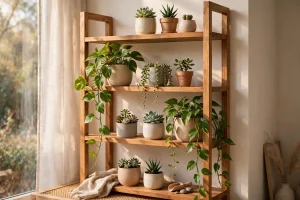
- Trailing: pothos or hoya takes zero floor space and uses a bookshelf you already own.
- Compact: peperomia or African violet fits a 15 cm shelf.
For displays that move with you, a leaning ladder shelf, a rolling plant stand with castors, or a tiered rack all work beautifully. You take them with you when you move. Hang macramé only from curtain rods or hooks that already exist, never a new ceiling anchor. Before you buy a big plant, walk its route: doorway, stairs or lift, then the car. If it does not fit, buy the smaller size and let it grow into the room, which is half the joy anyway.
Here is a happy tip about weight. A mature plant plus wet soil plus a ceramic pot is heavier than it looks. Lightweight plastic nursery pots inside decorative pots keep everything safe and easy to lift. Lift the plant out, water it in the sink or bath, let it drain for 10 minutes, and put it back. A 4-inch pot with wet soil weighs roughly 1 to 2 kg, so check the rating on any adhesive strip before you trust it. Hang ceramic pots on proper hooks, and save adhesive strips for light, easy pieces. Lift your pots once a month and peek underneath. A quick check keeps your shelves and floors looking lovely, and a saucer under every pot makes it easy.
Which plants are safe for pets and toddlers?
Keep two lists. One pet-safe, one child-safe, and only safe plants below 60 cm. The pet-safe list and the child-safe list are not the same list, so keep two lists and everyone in the house stays happy.
For the floor, where paws and little hands can reach, choose from the safe side.
- Parlor palm, areca palm, Boston fern, calathea or maranta, spider plant, peperomia, money tree, African violet, hoya and Christmas cactus.
- All kind to pets and children, and all gorgeous at floor level.
The calcium-oxalate plants look wonderful up high: pothos, philodendron, monstera, peace lily, dieffenbachia and ZZ plant. Put them on a shelf or in a hanging planter, safely out of reach, where their beautiful leaves can be admired. True lilies, oleander and sago palm seeds are best left out of a home with little ones and pets. There are so many gorgeous safe plants to choose from instead, and your home will look just as green and lovely.
The placement rule is simple and it works beautifully: only non-toxic plants below 60 cm, within reach of little hands and paws. Non-toxic plants go on the floor and low shelves, while the others go on high shelves or hanging planters. Re-check their reach every year, because a pothos vine grows longer and sags lower as it grows. Keep the bottom 24 inches for safe, soft, friendly plants only, which is the bottom-24-inches rule, and it works wonderfully. Floor plants love heavy, wide-bottomed pots that stay put, and save the spiky snake-plant swords for a higher spot where they look lovely.
Give cats their own green corner, a small pot of catnip or barley grass, and they will leave your other plants alone. It works beautifully.
If a little one ever chews a leaf, stay calm. You have got this.
- Take a photo of the plant.
- Gently remove any leaf bits from the mouth.
- Wipe the mouth with a damp cloth.
- Offer a small sip of cool water or milk.
- Watch happily for 30 to 60 minutes.
- If you notice breathing difficulty, severe swelling or persistent vomiting, or you cannot identify the plant, call poison control right away. In the US the number is 1-800-222-1222, and your local poison control is always there to help. They will tell you exactly what to do.
Most leaf-chewing moments pass quickly, and with safe plants on your floor, you can relax and enjoy the green.
What does a $50 living room plant starter kit include?
Three plants, three nursery pots, two cachepots, potting mix and saucers, for about $50 to $80. That buys you a whole living room of green.
The nursery-pot-inside-a-cachepot system is the easiest way to keep plants happy and your furniture safe. The plant lives in its light plastic nursery pot with drainage holes, and that pot sits inside a decorative cachepot. To water, lift the nursery pot out, water it in the sink, let it drain, and put it back. No water ever touches your shelf or floor.
Your starter kit is three plants: a snake plant, a pothos and a ZZ plant, or a spider plant if you have pets. Plus three nursery pots, two cachepots, a bag of potting mix and saucers. Prices vary by nursery, and local shops often beat the big stores on plant health. Check the underside of the leaves and the roots circling the pot before you pay. A healthy plant has clean leaves underneath, and its roots are not packed tight in a circle.
The cheapest way to grow your collection is propagation, and it is genuinely free and wonderfully fun. A pothos cutting roots in water in about a week. A spider plant baby roots even faster. A ZZ leaf cutting takes weeks, but it works. One $6 pothos can become a dozen plants in a season. If you need extra light, a $30 clip-on full-spectrum grow light does the job beautifully. Just follow the maker’s distance and timing. Give any new plant a happy two-week welcome in its own spot, away from the others. It is a lovely way to make sure everyone stays healthy and pest-free.
How do I make my living room look designed, not scattered?
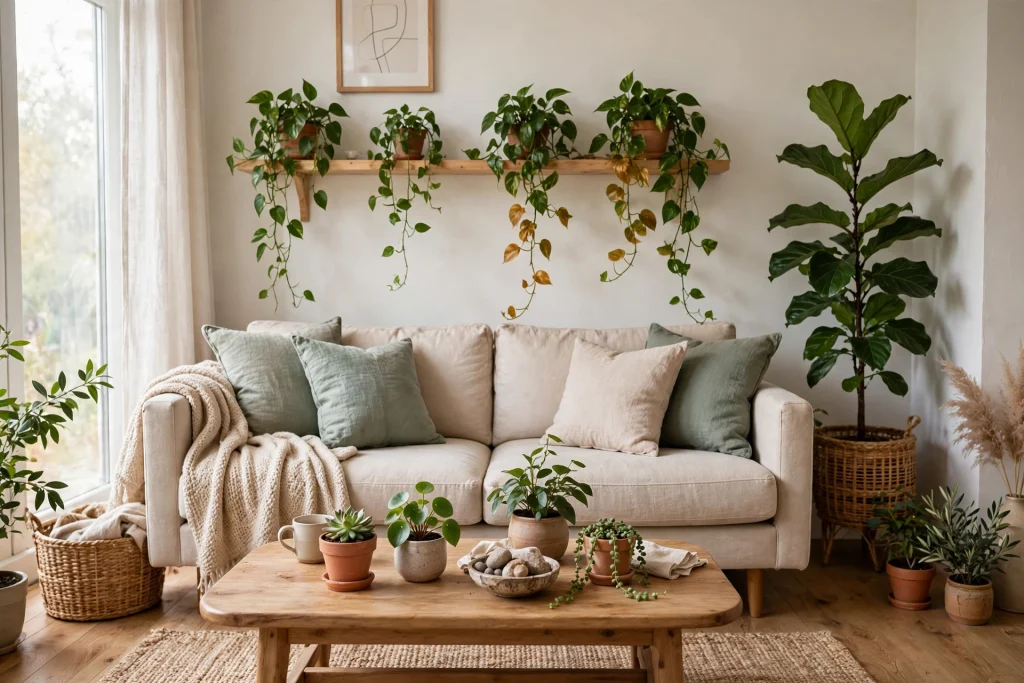
Group plants in odd numbers at three heights: one tall, two or three medium, one small. That is the formula that makes a room look designed.
Use odd numbers, three or five plants per group, and vary the heights so the eye travels up and down. A floor plant of 90 to 180 cm. A console or side-table plant of 30 to 60 cm. A coffee-table plant under 30 cm. That ladder of heights works beautifully in every room.
Repeat one pot colour or material in three places across the room, like a pot, a cushion and a throw, or a pot and a rug border. The whole room pulls together wonderfully. Leave a third of every shelf empty, because that empty space is what makes the plants stand out and shine. On the coffee table, keep it to one small low plant. It never blocks the person sitting opposite you or the TV. Behind the sofa, keep it to one tough plant you can see and water easily. Then sit down in every seat and check. Take a photo from the doorway. If the room looks calm and green from the door, you have got it right. It will make you smile every time you walk in.
What should I do in the first 3 to 6 months with my living room plants?
Change your care with the seasons and watch for the friendly signs your plants give you. That is part of the joy.
In summer, let the top 2 to 3 cm of soil dry before watering, and watch for fungus gnats, which love damp topsoil. Let the soil dry out, water from the bottom, and use sticky traps if they appear. Your plants will bounce back beautifully. In winter, water about half as often and move plants 30 cm closer to the window. Group them together or use a pebble tray for humidity. Keep them off cold glass and away from heater vents, and they will stay cosy and happy all winter long.
When a big floor plant needs repotting, water it the day before. Lay a tarp or use the bath. Lift the nursery pot out, loosen the roots gently, and move it into a pot just 5 to 7 cm wider with fresh mix. Move up just 2 to 3 inches, and your plant will settle in beautifully. Fast growers love repotting every 12 to 18 months, while slow growers are happy every 2 to 3 years. Dust the broad leaves weekly near the TV, because static pulls dust onto them, and clean leaves catch the light beautifully. Rotate each pot a quarter-turn weekly so plants grow evenly and look lovely from every side.
If something looks off, here is a quick, friendly guide.
- Yellow lower leaves: your plant asks for less water and more light. Let the soil dry and move it closer to the window, and it will bounce back.
- Crispy leaf tips: a gentle nudge to move the plant away from a draft or vent, and fresh growth will follow.
- Leggy plant with long bare stems: it reaches for more light. Move it up a tier or closer to the window, and it will fill out happily.
- Tiny flies: the topsoil is a little too wet, so let it dry out, and they will disappear.
Here is the lovely truth. Plants make your living room calmer, greener and happier, and that small daily ritual of caring for them is pure joy. The famous NASA study happened in sealed chambers, and a HEPA purifier does the heavy lifting for clean air. Your plants bring the calm, the beauty and the smile. That is the real gift. Our guide to grow lights will help if winter light is your problem. Our watering guide covers the finger test in detail.
What is the best first-week plan for living room plants?
Test the light, pick three spots, buy three plants. That is the whole first week, and here it is day by day.
- Day 1: do the hand-shadow test twice, morning and afternoon.
- Day 2: pick three spots, not three plants, and check the light, the walkway and the TV view for each one.
- Day 3: buy one upright plant, one trailer and one compact plant, all matched to those spots.
- Week 2: check your new plants for pests, and water for the first time by the finger test. Push your finger 2 inches into the soil: dry means water, damp means wait.
And here are seven smart moves that make everything easier.
- Start with three plants, not twelve, and let the collection grow with you.
- Water each plant when it needs it, not on one fixed weekly schedule.
- Remember low light means gentle light, not darkness.
- Check every decorative pot has drainage, or use a nursery pot inside it.
- Keep vines off rental walls, and use a small in-pot trellis instead.
- Leave breathing space on every surface, so the room feels calm and green.
- Test your own room, because two apartments in the same building can have completely different light.
Start with three plants, learn your room, and let the collection grow with you. Your living room will thank you for it, one green corner at a time.
Frequently asked questions
How many plants should I put in my living room?
Start with three plants: one tall, one medium and one small. That is enough to make the room feel green without crowding it, and you can add more slowly as you learn your light.
Do living room plants really clean the air?
Not in a meaningful way. The NASA study used sealed chambers, and you would need hundreds of plants to match normal ventilation. Plants are wonderful for calm, beauty and a daily ritual, and a HEPA purifier handles the air.
What is the easiest living room plant for a beginner?
A snake plant. It thrives in low light, needs water only every 2 to 3 weeks in summer, and looks beautiful in any corner. A pothos is a close second if you want a trailing plant.
Can I keep plants in a living room with a cat?
Yes. Choose pet-safe plants like spider plant, parlor palm and calathea for the floor, and keep pothos, monstera and ZZ plant up high. Give your cat its own pot of catnip or barley grass.