Bedroom Plant Styling for Better Sleep
Your bedroom is the one room that has to do two opposite jobs at once. It needs to stay dark and quiet enough for sleep, and bright and alive enough for a plant. Think of it like a good friend who is great at parties and great at lazy Sundays. Once you see how both sides work, everything else falls into place beautifully.
What do plants actually do for your sleep?
You have probably heard that plants fill your bedroom with oxygen while you sleep and purify the air. Okay, real talk: here is the honest version, and it is good news, because the real benefit is better than the myth. The famous NASA Clean Air Study happened in 1989 in small sealed chambers, not bedrooms. A review found you would need 10 to 1,000 plants per square metre to match normal ventilation. Another estimate put it at around 680 plants per 93 square metres to match laboratory rates. So no, your snake plant is not going to replace your air purifier, and that is totally fine, because that was never its job. A HEPA purifier does the heavy cleaning, and your plant does the calming, and together they make a lovely bedroom. Think of plants as a gentle companion for better sleep, a calmer room and a lovely evening ritual. If you have persistent insomnia, see a doctor, and that is the kindest advice anyone can give you.
Here is what plants actually do, and it is lovely. Most sleep plants fall into two groups. CAM plants, like snake plant, aloe, orchid and Christmas cactus, release a small amount of oxygen at night. C3 plants, like peace lily, lavender and pothos, breathe in a little oxygen at night, just like you do. Either way, the oxygen boost is tiny, and the real gift is how calm the room feels. Looking at greenery lowers cortisol, your stress hormone, within minutes. Caring for a plant lowers blood pressure. The best part is the ritual. Five quiet minutes in the evening checking your plants replaces five minutes of phone scrolling before bed, and that swap is what genuinely helps you wind down. Your brain knows the difference, and it will thank you. A peace lily can raise humidity by up to 5 percent, a lovely little boost when your room is dry. The target for a bedroom is 30 to 50 percent. Your plant gives you a gentle reason to slow down, a calmer room your brain associates with wind-down, and a scent cue where it applies. That is the honest magic, and it works beautifully every single night. For more on the fresh-air side of things, our guide to the best indoor plants for clean air is a good companion read.
Which plants should I pick for my bedroom?
Think of it like picking the perfect plant for your room. Every bedroom list shows the same eight to ten plants with a light label like low light or bright indirect. Here are two ten-second tests that tell you what that means in your room, and they work in any bedroom. First, the book test. Can you comfortably read at noon without a lamp where the plant will sit? If yes, most low-light plants will be happy there. If no, a snake plant or a ZZ plant will be happy there, or a little extra light opens up more choices. Second, the hand-shadow test. Hold your hand 30 cm above the spot at midday. A soft visible shadow means low light. No shadow at all, and a grow light will turn that spot into a happy home. Your eyes adapt to darkness far better than plants do, so trust the test, not your eyes.
Here is a starter list with honest light, water and failure signs, so you know exactly what you are getting. Snake plant loves very low light, water every 3 to 4 weeks when the soil is fully dry, and it will thrive for years. The snake plant is basically that low-maintenance friend who never asks for much and is always there for you. ZZ plant loves very low light, let the soil dry fully, and slow growth is completely normal. Pothos loves low to bright light, water when the top 2 to 3 cm feels dry, and trim the leggy vines to keep it full. Spider plant loves medium light and tolerates low light. Water when the top 2 to 3 cm feels dry, and brown tips just mean dry air or fluoride in the water. Peperomia loves low to medium light, stays compact and easy, and water when the top 2 to 3 cm feels dry. All of these stay a sensible size for a bedroom. Areca palm and rubber plant can grow to 10 feet tall, so save them for a bigger room and keep the bedroom calm. Every one of these plants is a forgiving friend, and they will grow with you as you learn.
Here is a happy distinction that makes choosing easier. Tolerates low light and loves low light are two different things, and picking a plant that truly loves your light makes all the difference. A pothos stays full and green in a brighter spot. In dim light it stretches out and fades, so match the plant to the light and it will thrive. A peace lily flowers happily in a brighter spot, so give it the light it loves and it will reward you. Variegated plants keep their pretty patterns in a brighter spot, so give them the light they love. If your room is dark, pick the plants that genuinely love it, and they will thrive where others only survive. Lavender, aloe and jasmine all need sun, and calathea needs humidity. Save them for a bright room, and pick the forgiving plants above for a dark bedroom instead. Our guide to snake plant care indoors is a great place to start if you want the easiest win of all.
How do I style a small bedroom without making it feel smaller?
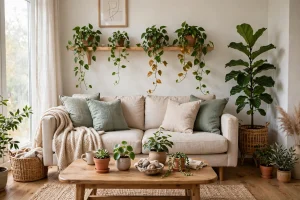
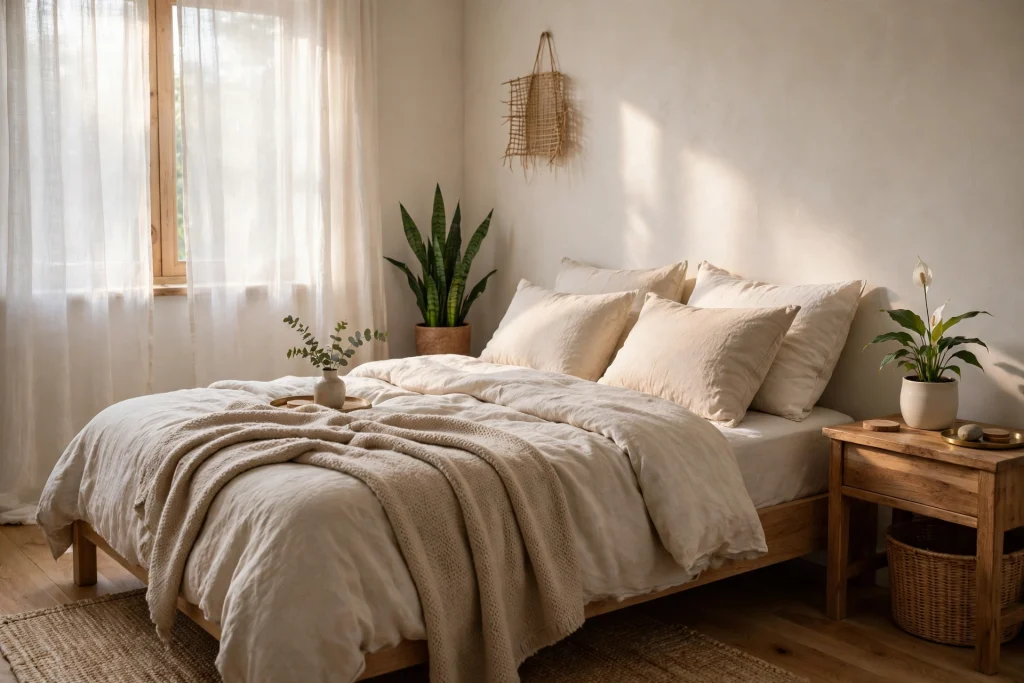
A calm bedroom needs just one or two plants, grouped together so they read as one lovely feature. Use one pot colour family, white, light terracotta or warm cream, and favour vertical lines over wide foliage. A tall snake plant grows straight up and fits a tiny room beautifully, while a monstera or fiddle-leaf fig loves a bigger space.
Now the nightstand reality audit that makes all the difference. Your nightstand is already full: lamp, charger, book, water glass, everything in its place, and not an inch to spare. A standard nightstand is only 40 to 45 cm wide, and it already holds all of that. A pot needs a saucer and 15 to 20 cm of clearance so it sits safely through the night. The rule is simple. If you can fit your palm flat beside the pot, it has a happy home there. Use a heavy, wide, matte pot, always with a saucer, and keep trailing vines on the far side from the pillow.
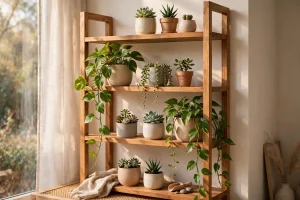
Better spots for a small room are easy to find. One tall snake plant in the 15 cm gap between the bed and the wall grows up and stays out of the way. One trailing pothos on a high shelf can cascade beautifully and leave the floor clear. Keep the floor clear in the 3 a.m. bathroom path, and your sleepy walk stays safe and easy. For renter-safe vertical options, a tension-pole floor-to-ceiling stand takes less than 15 cm of floor diameter and holds 4 to 6 pots beside the window. A clamp-on window-sill rod works beautifully too. Adhesive hooks are perfect for plants under 1 kg, like a small peperomia or an air plant. Check the weight, and give a wet 20 cm terracotta pot a sturdy shelf to sit on. Keep plants to the side of the pillow, and your sleep stays peaceful and dry. For more ideas that fit a tighter space, see our picks for the best plants for small bedrooms.
How do I keep a plant alive in a blackout-curtain bedroom?
Blackout curtains help you sleep beautifully, and your plant just needs a little daytime light to stay happy, and the fix is simple. Your plant is not asking for much, just a little sunshine, like a friend asking for one more coffee. Open the blackout curtains for 2 to 4 hours in the daytime, because morning light is enough for a snake plant, a ZZ plant or a pothos. Or rotate the plant to a brighter room for the day and bring it back at night. Think of it as a little day out for your plant. Two to three days a week in a bright spot keeps a snake plant alive and happy. A plant loves 6 or more usable light hours a day, and a few hours of open curtains gives it exactly that.
If you need a grow light, choose it with sleep in mind. Use a warm-white full-spectrum grow bulb in a normal desk or clip lamp, on a timer, and switch it off by 7 or 8 p.m. Choose warm-white light for your bedroom, and save the purple or pink grow lights for the greenhouse, where they belong. A bulb is a small one-off buy, and it keeps your plant happy for years.
Closed curtains keep the air still behind them in winter, so give your tropical plants a little space from the cold glass. Keep your pots a few feet back from the glass, not pressed against a cold window, and your plants will stay much happier through the cold months.
How do I keep plants happy in an AC bedroom?
Air conditioning is the most under-covered bedroom topic, and it is the one that rewards a little attention. Your AC loves the cold, and it never asks how you feel about it. An air conditioner drops the humidity to 30 percent or lower, while most houseplants want 40 to 60 percent. The ideal humidity for sleep is 30 to 50 percent. The sweet spot where plant and sleeper both feel happy is 40 to 50 percent, and it is easy to find.
Keep the room at 18 to 24 degrees Celsius, which is 65 to 75 degrees Fahrenheit, and check with a digital hygrometer, which costs under $15. The AC-safe picks are snake plant, ZZ plant, pothos, spider plant and air plant, all of which tolerate low humidity beautifully. Save calathea, areca palm, most ferns and croton for a room without AC, where they will thrive, and let the AC-safe picks shine in your bedroom. Peace lily is surprisingly hardy in AC, and it loves a little extra moisture, so keep its soil happy and it will thrive.
Distance matters more than the word away. Keep plants a minimum of 6 feet, about 1.8 metres, from the vent. Think of the vent as the cold spot at the party: nobody wants to stand right next to it. Happy leaves are green and perky. If you spot brown crispy edges, yellowing or wilting, your plant is just asking for a little more distance from the vent, and a small move fixes it. Group three to five plants together for a little microclimate. Use a pebble tray, a shallow dish with pebbles and water, with the pot sitting on top of the pebbles. Misting is a lovely ten-minute refresh, and morning mist is the happy time, because wet leaves love the morning sun and dry off beautifully. Save misting for the morning, and your leaves will dry off beautifully before bedtime. Skip misting on fuzzy leaves, and they will thank you.
One more honest note. Transpiration is real, and one peace lily adds a gentle touch of humidity, while a small humidifier does the heavy lifting in an AC bedroom. If your humidity is below 30 percent, a small humidifier does the job beautifully, and your plants add the calm and the green. Here is a free, practical tip to love. AC condensate water is distilled-like and safe for plants if you collect it cleanly. Our guide to the best humidity levels for houseplants will help you find the sweet spot for your room.
How do I use scent for better sleep?
Lavender and jasmine appear on every bedroom plant list, and they smell wonderful. Scent is a dose, and getting the dose right is everything. Think of scent like a good playlist: one song at the right volume, not the whole album at once. The chemistry is real. Linalool, the main compound in lavender, binds to GABA receptors, the same system anti-anxiety medicines work on. EEG studies show more slow-wave deep sleep and less waking. Jasmine’s benzyl acetate also acts on GABA. In controlled trials, jasmine-scented rooms showed less restless movement than both unscented rooms and lavender rooms, with higher morning alertness. Lavender gets most of the attention, so give jasmine equal weight, and it will reward you.
Here is the part that makes all the difference. A living lavender plant gives you a gentle whisper of linalool, while a diffuser gives you a stronger dose, and both have their place. Lavender is the friend who shows up with a candle and a hug. Crush a leaf gently before bed to release the scent, and enjoy the gentle fragrance for what it is, a lovely cue that helps you wind down.
Distance is the prescription. Keep a scented plant at least 1 to 2 metres from the pillow, across the room, on the windowsill, where its scent can drift gently to you. One scented plant is the perfect amount for a small bedroom, and it will fill the room just right. Gardenia is the strongest of all, so give it the most space, and its scent stays lovely instead of overwhelming. Jasmine is lovely and quiet, and it shines at a little distance. Valerian’s earthy root scent is best enjoyed from across the room. The test rule is simple. One small plant, two nights, windowsill first. If you wake with a headache, a stuffy nose or vivid restlessness, simply move it out, and your sleep will thank you. Scent is personal, and your nose gets used to it overnight, so trust how you feel in the morning.
If you are scent-sensitive, unscented plants are your happy choice. A snake plant, a pothos or a spider plant gives you the calm without the perfume. A dried lavender bundle kept away from your nose beats a live lavender plant in a dark room. If you share the bedroom, agree the scent together, or keep it in the living room. Two people, one bedroom and one scent is a conversation worth having.
What if I sneeze or wake up stuffy?
Judge every bedroom plant on three tests. Low pollen, because it rarely flowers indoors and its pollen stays put. Low mould risk, because it likes to dry out between waterings. Easy to clean, because smooth, wide leaves wipe in seconds. Think of it like a first date: you want to know what you are getting into before you commit. Smooth, wide leaves are the easiest to keep clean. Fuzzy, frilly or tiny leaves, like African violet, Boston fern and English ivy, love a little extra wiping.
The best picks are snake plant, ZZ plant, pothos, spider plant, parlor palm and peperomia, smooth-leaf types only. Save true lilies, hyacinth, gardenia, chrysanthemum and potted azalea for the living room, where their scent and pollen have room to breathe. Weeping fig and rubber plant carry latex in their sap, so wear gloves to prune them. If latex and your skin do not get along, give them a happy home elsewhere and pick from the safe list instead.
The humidity number is simple. Your bedroom target is 30 to 50 percent, with a sweet spot of 40 to 45 percent for sleep. Above 50 percent, the air gets a little too friendly for dust mites and mould, so keep it in the sweet spot. Above 60 percent, it is time to dry the air a little, and your plants and your lungs will thank you. Houseplants want 40 to 60 percent, so the happy overlap is 40 to 50 percent, and a digital hygrometer under $15 tells you exactly where you stand. Your hygrometer is basically the friend who always tells you the truth, even when you do not want to hear it. A peace lily raising humidity by 5 percent is a lovely boost when you are below 40 percent. If you are already at 55 percent in a humid bedroom, your room is happy as it is, and extra transpiration is not what it needs. Grouping five to seven plants together noticeably raises a small room’s humidity, so use that when your room is dry.
Mould only becomes a story when you disturb the soil, and undisturbed houseplants are happy and quiet. Repotting, stirring dry soil and watering are the moments to be gentle, and a mask and fresh air make them easy. Water only when the top 2 to 3 cm feels dry, make sure the pot has a drainage hole, and empty the saucer within 30 minutes. Top-dress the soil with coarse sand or fine gravel to keep the surface dry. If white fuzz appears, scoop the top 2 to 3 cm outdoors while wearing a mask, and replace it with fresh mix. Your plant will be happy again. Fungus gnats are your soil’s friendly way of saying it is staying too wet, and a drier top layer sends them away. Let the top dry out, use yellow sticky traps, and add BTI, mosquito bits, to the watering water. Do your repotting outside the bedroom. Here is a useful test. Move the plant out for one to two weeks, and if you feel better, you have found your answer. Plants are a lovely companion to your asthma medicine and HEPA filter, and together they make a happy bedroom.
One more easy fix. A peace lily’s flower stalk produces pollen, so snip the stalk at the base as soon as it opens. You keep the beautiful leaves and skip the pollen. The same goes for a Chinese evergreen flower spike.
Which bedroom plants are safe for pets and little kids?
The safe swaps look just as good. Haworthia looks like aloe but is completely non-toxic, so use it instead of aloe. Spider plant trails just like pothos, so use it instead of pothos. Parlor palm, cast iron plant, peperomia, prayer plant and Boston fern form a pet-safe core list that covers every spot in the bedroom.
Here is the table that keeps everyone safe. Pothos and peace lily contain insoluble calcium oxalates, which cause oral irritation, intense burning, drooling, vomiting and difficulty swallowing in cats and dogs. Keep them on a high shelf, or choose a safe swap, and everyone stays happy. Snake plant contains saponins, and a nibble brings nausea, vomiting and diarrhoea, so keep it on a high shelf where curious paws cannot reach. ZZ plant contains calcium oxalate crystals, so give it a high shelf too. True lilies are gorgeous, and they are the one flower to enjoy at the florist. Even a little pollen can cause kidney failure in cats within 36 hours, so the safe list above is your happy answer. Cats are clever, curious, and into everything, so a high shelf is a good start, and the safe list is your peace of mind.
Kids are their own wonderful category, and the ASPCA lists are written for cats and dogs, so here is the child version. Little kids explore the world with their mouths, so think of childproofing like baby-proofing a coffee table: a little planning, a lot of peace of mind. For toddlers the mechanism is the same calcium-oxalate needle crystals, and a curious taste brings immediate mouth burning, drooling and swelling, so keep those plants up high. Here is the reassuring part. More than 90 percent of plant ingestions by children under five cause no symptoms or only minor irritation, according to US poison-control data. Stay calm, and do move the plants up.
Childproofing goes beyond toxicity. Watch for small things a toddler could chew: loose leaves, berries, seeds, soil, fertiliser pellets and small pebbles. Use wide, heavy-bottomed pots and only stable floor plants, and your climbing toddler stays safe. Cover the soil with large stones, not small pebbles, or use a fitted cover, and your toddler stays safe. Keep spiky plants like aloe points and cactus up high, where little hands can admire them safely. Teach your child to look, smell and help water, and they will love being your little gardener. If a little one takes a curious taste, clear the mouth, offer something cool to drink, and call your local poison information line for friendly advice. If breathing or swallowing feels difficult, or there is heavy drooling with distress, call for urgent care right away, and help is there for you. One funny exception: spider plants are non-toxic, but they contain compounds that make some cats obsessively chew them, so expect a chewed plant and a happy cat.
How do I start for under $25 and keep it alive in 5 minutes a night?
Bedroom plants love a small budget. A pothos costs $5 to $15, a spider plant $2.50 to $4.50, a snake plant $5 to $15. A full bedroom of three to five plants costs $25 to $40, or $0 to $25 with cuttings and clearance finds. The pot and saucer, the soil and a hygrometer are the happy extras to budget for too. Free sources are everywhere: cuttings from friends, Facebook Marketplace and Buy Nothing groups, plant swaps, and big-box clearance racks.
Propagation has happy timelines to follow. A pothos cutting with a node grows roots in 1 to 3 weeks in water, and you change the water weekly. A spider plantlet grows roots in 3 to 7 days, and you pot it up when the roots reach 1 cm. A snake leaf cut into 8 cm sections grows roots in 6 to 8 weeks. One $6 pothos becomes a dozen plants in a season. Growing a plant from a cutting is one of the happiest free things in the world, and your friends will love you for the free pothos. Here is the whole rule: a node is where the roots begin.
Make Sunday your plant-checking day. Sunday is your weekly check-in with your plants. Check the soil, and water only what needs it. Bedroom plants use water more slowly because they get less light, so they stay wet longer, and a gentle watering hand keeps them happy. Here is the five-minute wind-down for a light sleeper. Put the phone down, walk around the room, and finger-test the soil. Turn each pot a quarter-turn so it grows evenly, remove any tired leaf, and notice the new growth. Do it in the evening, and water in the morning, when your plants wake up thirsty and happy.
Once a week, spend ten minutes wiping the leaves with a damp microfibre cloth. A damp cloth is the happy tool, and it lifts the dust away beautifully. Check under the leaves for spider mites and mealybugs, and a quick check keeps them from settling in. Give any new plant two weeks in its own happy corner before it joins the bedroom. Once a month, rinse spider plant and palm fronds in the shower, check the drainage, and trim pothos vines before they reach 3 metres. Seasonally, move plants as the light shifts, and water less in winter. A snake plant likes water every 2 to 4 weeks in summer and monthly or less in winter.
Here is the kindest advice in this article. If three pothos have not thrived for you, or your room has no window at all, a good faux plant in one spot is a lovely choice. It keeps your room calm and green, and there is joy in that. Keep one real plant where the light is best, and let the faux one hold the dark corner. Start tonight with one plant, give it the best spot in your bedroom, and keep the rest of the room simple. Good sleep starts with a calm room, and a calm room starts with one healthy plant.
Frequently asked questions
Which plants are best for a bedroom?
Snake plant, ZZ plant, pothos, spider plant and peperomia are the best bedroom plants. They tolerate low light, need little water, and stay a sensible size. Snake plant and ZZ plant are the easiest of all, and they forgive a dark room and a forgotten watering.
Do bedroom plants really help you sleep?
What plants do is calmer and simpler: looking at greenery lowers stress within minutes. A five-minute evening plant check replaces phone scrolling before bed, and that wind-down ritual is what genuinely helps you sleep.
Are bedroom plants safe if I have a cat?
Spider plant, parlor palm, peperomia, prayer plant and Boston fern are all safe for cats. Haworthia looks like aloe and is safe too. Pothos, peace lily, snake plant and ZZ plant are happiest on a high shelf, out of curious paws’ reach. True lilies are the one flower to leave at the shop if you have a cat. Even their pollen can trouble a cat’s kidneys, and the safe list above has plenty of beautiful choices.
How often should I water bedroom plants?
Check the soil every Sunday, and water only what needs it. Bedroom plants use water slowly because they get less light. Snake plant and ZZ plant are happy every 3 to 4 weeks, only when the soil is fully dry. Pothos, spider plant and peperomia drink when the top 2 to 3 cm feels dry. In winter, give them even less water, and they will rest happily until spring.